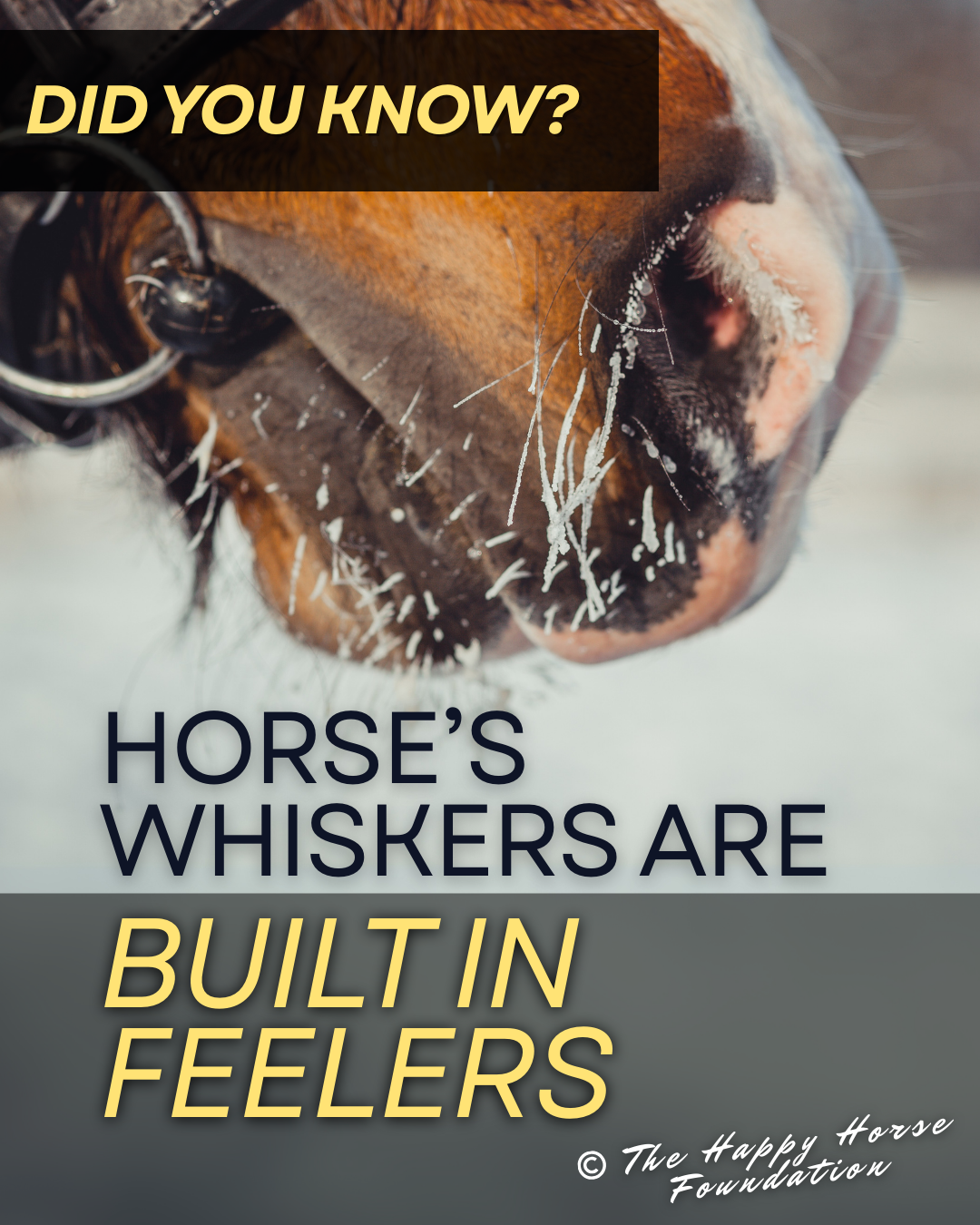
Horses whiskers are built-in feelers
The stiff hairs around a horse’s muzzle and eyes are called vibrissae, commonly known as whiskers.
Unlike ordinary body hair, vibrissae are deeply rooted and richly supplied with nerve endings and blood-filled follicles, making them highly sensitive to touch and vibration.
These whiskers act like built-in feelers, allowing horses to detect and interpret subtle changes in their surroundings.
They help a horse:
- Locate food and water with precision, especially in low light or when objects are close to the face but outside their narrow binocular vision.
- Navigate blind spots, particularly under the muzzle and directly in front of the forehead where their eyes cannot see.
- Avoid injury, by alerting them to obstacles, fencing, or even electric wires before their skin makes contact.
Because they form such a critical part of a horse’s sensory map, trimming or removing whiskers can reduce their ability to interpret the world safely. This is why some countries – including those under the FEI (Fédération Equestre Internationale) – have made whisker trimming illegal in competition, recognising the welfare implications.
By respecting and preserving whiskers, handlers support the horse’s natural sensory toolkit, giving them confidence and reducing the risk of accidents or stress in unfamiliar environments.
The Happy Horse Foundation is a registered charity with the Australian Charities and Not-for-profit Commission

The Happy Horse Foundation is a registered charity with the Australian Charities and Not-for-profit Commission

The Myth of the ‘Good Doer’ or ‘Easy Keeper’
The Myth of the ‘Good Doer’ or ‘Easy Keeper’ The Myth of the ‘Good Doer’ or ‘Easy Keeper’ Why everyday labels often hide discomfort in…
Read More
Pain ≠ Behaviour
Pain ≠ Behaviour Why everyday labels often hide discomfort in horses Pain in horses rarely looks the way we expect it to. It doesn’t always…
Read More
Gastric Ulcers in Horses
Gastric Ulcers in Horses How management, behaviour and biology interact to create ulcer risk How the horse’s digestive system functions A horse’s gastrointestinal tract is…
Read More